Introduction
If you’ve been developing with Flutter for more than a few years, Provider has likely been your bread and butter. It was the “official” recommendation from Google for years, it replaced the clunky ScopedModel, and it taught us all how to use InheritedWidget without losing our minds. But here we are in 2026, and the landscape has shifted beneath our feet.
You aren’t reading this because you don’t know how to use Provider. You’re reading this because you’re starting a new scalable project, or perhaps maintaining a legacy codebase, and you’re asking the uncomfortable question: “Is it irresponsible to stick with Provider in 2026?”
The short answer is: You probably shouldn’t start a new enterprise app with raw Provider today. The ecosystem has matured, and tools like Riverpod and BLoC have solved the very specific pain points that Provider—by design—cannot fix.
In this analysis, we are going to look at the state of Flutter state management in 2026. We will strip away the hype and look at the raw technical trade-offs between sticking with the classic Provider and migrating to modern, compile-time safe alternatives like Riverpod or strict architectural patterns like BLoC.
The Problem with Provider in 2026
To understand why we are moving away from Provider, we have to look at what it actually is. Provider is essentially a wrapper around InheritedWidget. It relies heavily on the Widget Tree and BuildContext.
In 2019, this was revolutionary. In 2026, it is a liability for large apps. The biggest issue isn’t performance; it’s safety and refactoring confidence.
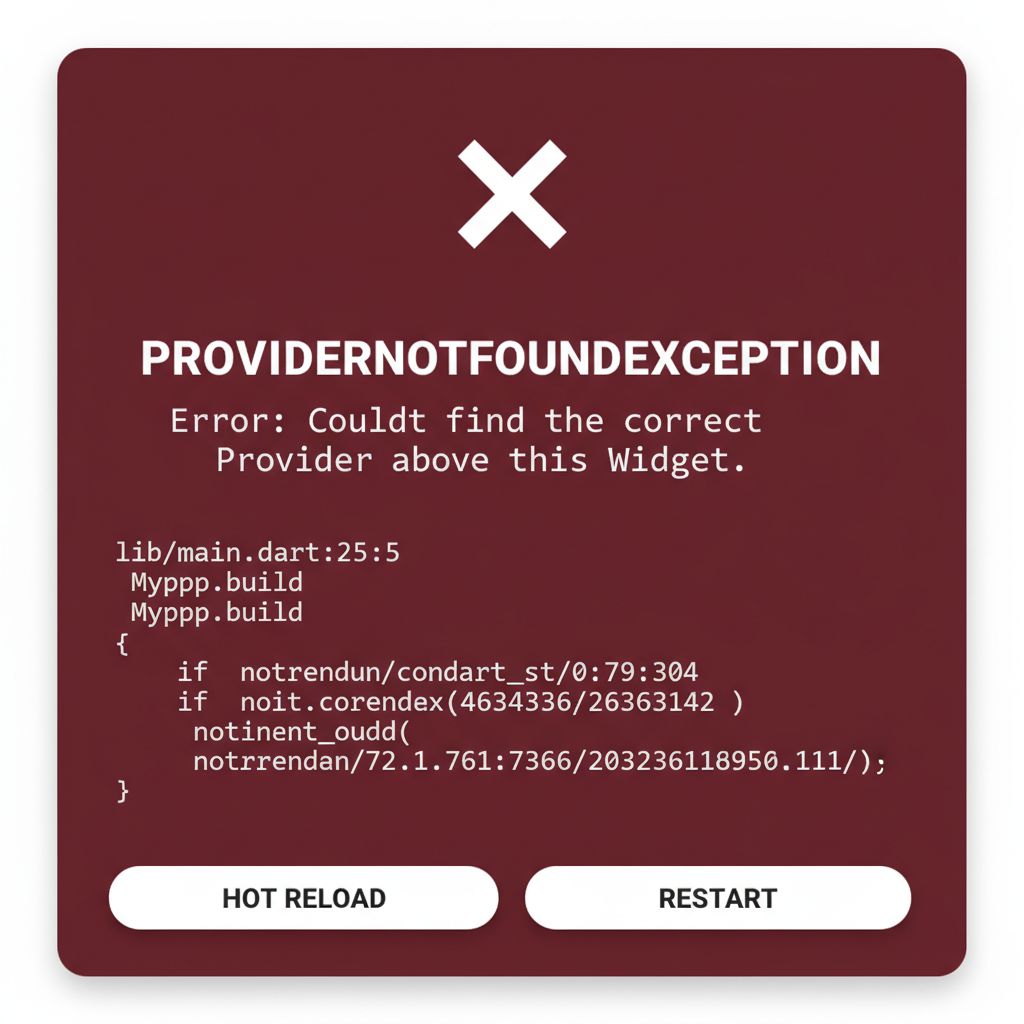
The image above haunts every Flutter developer. Because Provider is tied to the widget tree, if you try to access state in a modal, a dialog, or during a navigation transition where the context hierarchy is ambiguous, your app crashes at runtime. There is no compile-time warning telling you, “Hey, this widget doesn’t have access to that data.”
Furthermore, as apps scale, “Provider Hell” becomes real. You end up with a MultiProvider at the top of your app that is 50 lines long, injecting every single controller globally because you are too afraid to scope them locally and risk a `ProviderNotFoundException`.
The Modern Successor: Riverpod
Remi Rousselet, the creator of Provider, realized these architectural limitations years ago and built Riverpod. In 2026, Riverpod isn’t just “an alternative”; it is effectively Provider 2.0.
Why Riverpod Wins on Architecture
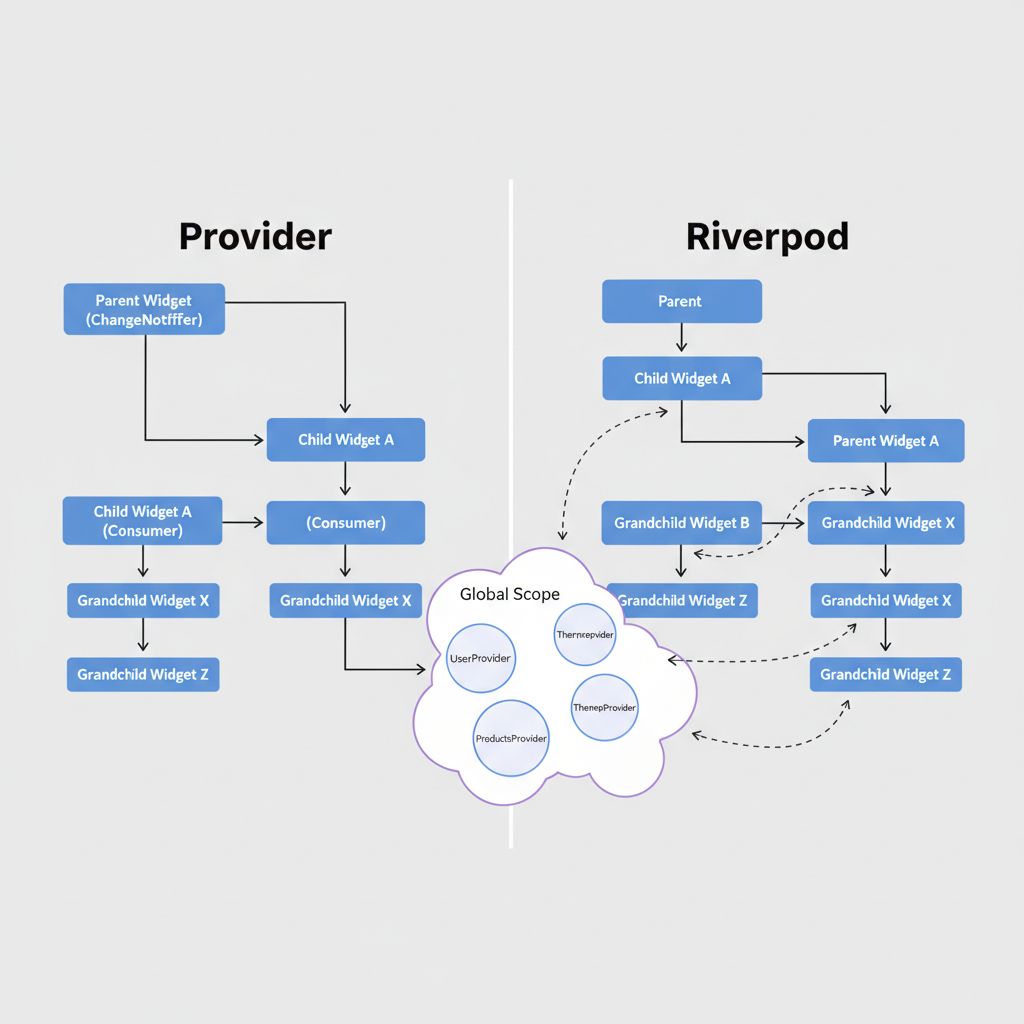
Riverpod decouples state from the Widget Tree. This sounds like a minor technical detail, but it changes everything. By declaring providers as global constants (don’t worry, they are immutable definitions, not global variables), you can access them anywhere without a BuildContext.
This solves the two biggest headaches of Provider:
- No more ProviderNotFoundException: It is literally impossible to trigger this error in Riverpod. If the code compiles, the provider exists.
- Context-free composition: You can combine state logic (e.g., “Get the current user ID, then fetch their profile”) inside your business logic layer without ever touching a widget.
The Power of Generators
In 2026, if you are using Riverpod, you should be using the Riverpod Generator. It uses Dart macros (or build_runner, depending on your setup) to write the boilerplate for you. You simply annotate a function, and it generates the provider, the family, and the auto-dispose logic.
// The 2026 way to define state
@riverpod
Future<List> fetchProducts(Ref ref) async {
  final api = ref.watch(apiProvider);
  return api.getProducts();
}
Compare that to the manual setup required for a FutureProvider or ChangeNotifierProxyProvider in the old days. The reduction in cognitive load is massive.
The Enterprise Standard: BLoC (Business Logic Component)
While Riverpod offers flexibility and speed, Flutter BLoC remains the heavyweight champion for strict enterprise environments. If you are working in a banking app, healthcare, or a team of 30+ developers, BLoC is likely still your best bet.
Why BLoC is Still Relevant
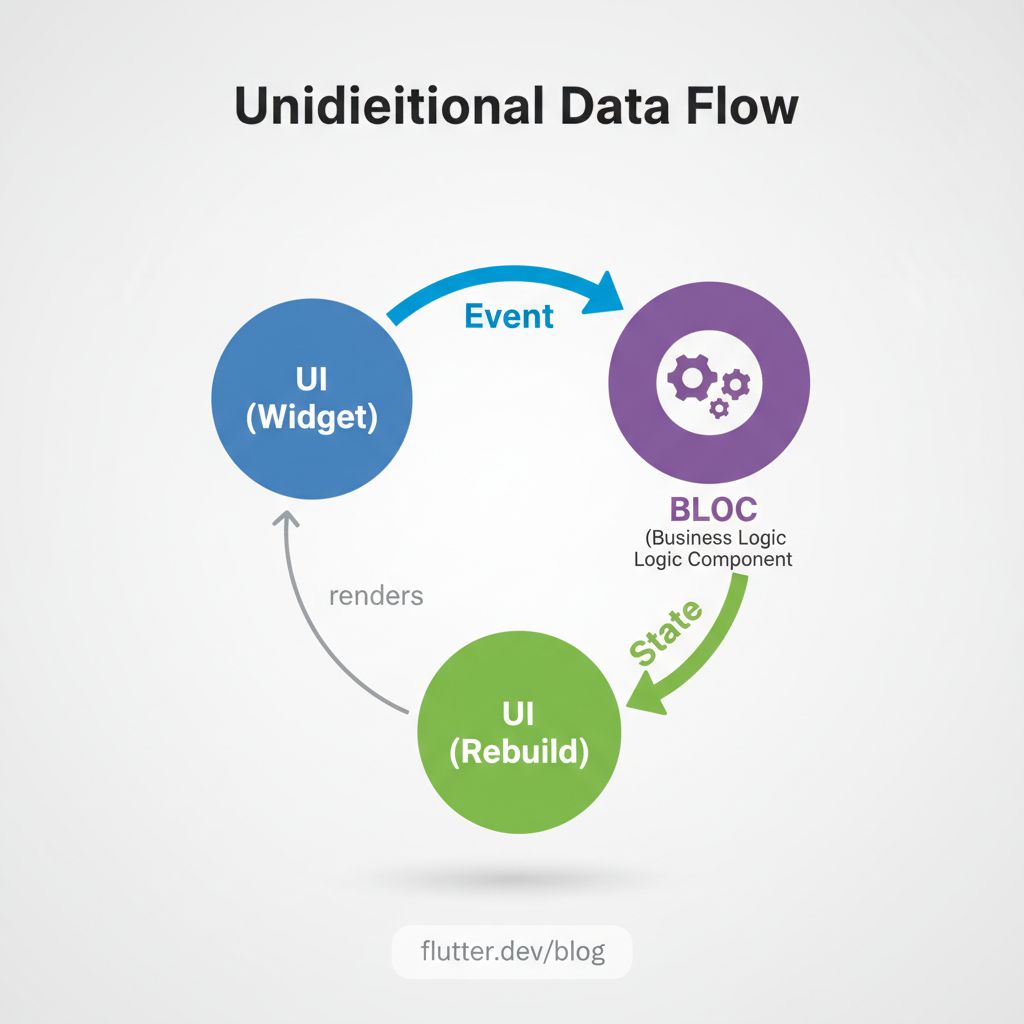
BLoC forces you into a unidirectional data flow. You must send an event to change state. You must emit a new state to update the UI. This strictness is annoying for a solo developer building a to-do list, but it is a lifesaver for a large team debugging a race condition.
In 2026, BLoC has also adopted code generation via libraries like freezed and stricter analysis options, making it less verbose than it was in 2020. However, the core philosophy remains: Traceability over convenience.
Comparative Analysis: 2026 Edition
Let’s look at the hard data. I’ve used all three of these in production apps with over 100k users. Here is how they stack up today.
1. Safety & Reliability
- Riverpod: ⭐⭐⭐⭐⭐ (Best). Compile-time safe. No runtime crashes due to missing providers.
- BLoC: ⭐⭐⭐⭐. Very safe due to strict streams, but you still need to provide the BLoC to the widget tree (usually via
BlocProvider), soBlocProvider.of(context)issues can theoretically happen, though rare. - Provider: ⭐⭐. Relies entirely on runtime checks. Refactoring is risky.
2. Boilerplate & Developer Experience
- Riverpod (with Generator): ⭐⭐⭐⭐⭐. Extremely concise. The annotations handle the heavy lifting.
- Provider: ⭐⭐⭐. Moderate boilerplate, but
ConsumerandSelectorwidgets can get messy. - BLoC: ⭐⭐⭐. Even with extensions and code gen, defining Events and States for simple toggles feels like overkill.
3. Scalability
- BLoC: ⭐⭐⭐⭐⭐. The structure forces decoupling. It scales indefinitely.
- Riverpod: ⭐⭐⭐⭐⭐. Scoping and overrides make it excellent for modular architecture.
- Provider: ⭐⭐⭐. Becomes difficult to manage dependencies as the graph grows complex.
Migration Strategy: Moving from Provider
If you have a massive app built on Provider, do not panic. You do not need to rewrite the whole thing next week. The beauty of the Flutter ecosystem in 2026 is interoperability.
The “Strangler Fig” Pattern:
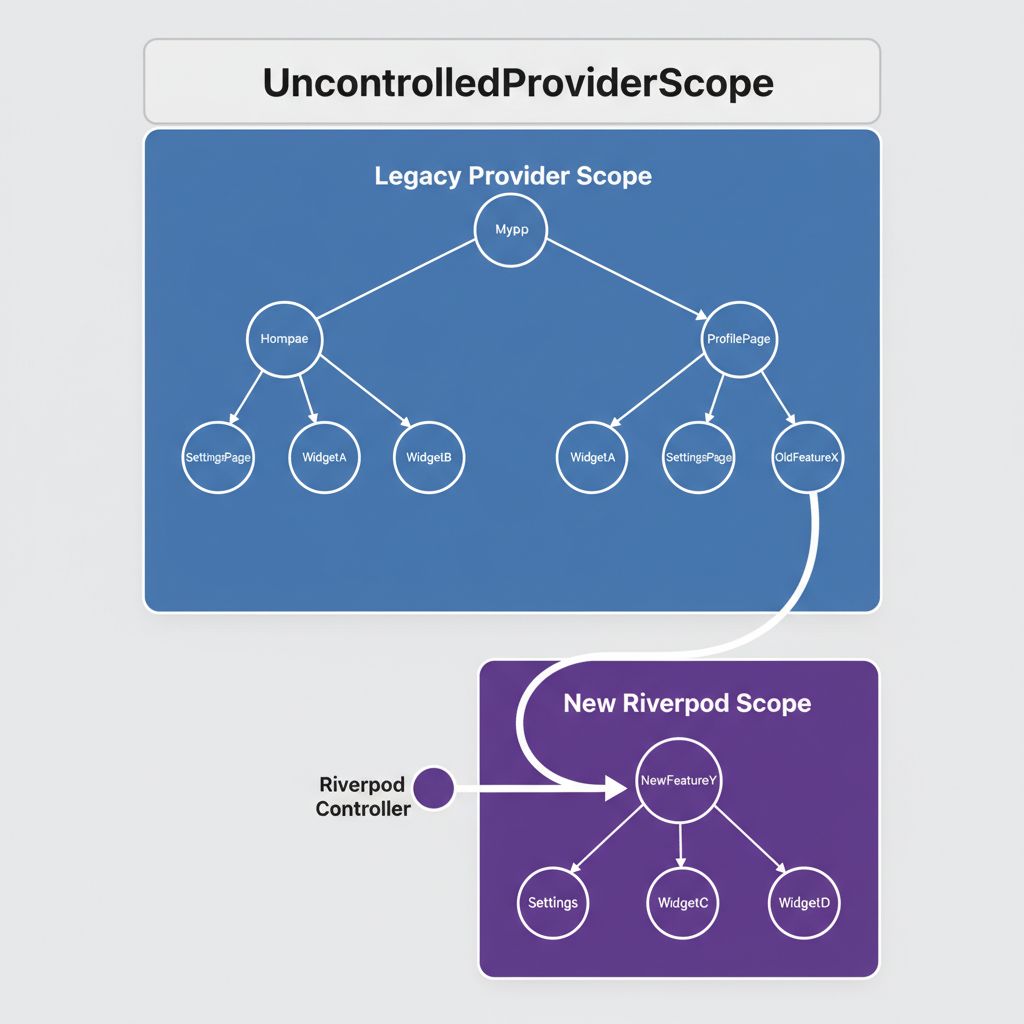
- Install Riverpod alongside Provider. They can coexist in the same project without conflict.
- Migrate Leaf Nodes first. Find a simple controller (like a ThemeController or a UserSettings service) that doesn’t depend on other providers. Convert it to a Riverpod provider.
- Bridge the Gap. You can read a Riverpod provider inside a legacy Provider widget using a bridge, or vice versa, though it’s cleaner to keep them separate.
- Stop adding new things to Provider. Make a team rule: All new features use Riverpod.
Common Mistakes to Avoid
Even with modern tools, I see senior developers making rookie mistakes when adopting these new libraries.
⚠️ Mistake 1: Treating Riverpod like a Service Locator
Just because you can read a provider anywhere doesn’t mean you should read it inside a build method without watching it. Always use ref.watch inside build methods to ensure the UI updates when data changes. Using ref.read in a build method is a classic bug that leads to “stale” UI.
⚠️ Mistake 2: Over-using Global State
Not everything needs to be in a global store. If a variable is only used inside a single widget (like the scroll offset of a specific list or a form field’s temporary text), use flutter_hooks or a simple StatefulWidget. Don’t complicate your architecture for ephemeral state.
💡 Tip: Use “Flutter Signals” for Granular Reactivity?
You might have heard of Signals. It’s gaining traction in 2026 for fine-grained reactivity, similar to SolidJS or Preact in the web world. It is excellent, but it is often better used inside a Widget for complex animations or local interactions, rather than replacing your entire global state management architecture.
Final Verdict: What Should You Use?
Decision fatigue is real. Here is the shortcut based on my experience shipping apps this year.
- Choose Riverpod if: You want the most modern, type-safe, and flexible experience. You want to move fast but keep your code clean and testable. It is the default choice for 90% of apps in 2026.
- Choose BLoC if: You are working in a strict enterprise environment where audit trails of user actions are mandatory, or you have a team of developers with varying skill levels and need to enforce a rigid structure.
- Stick with Provider if: You are maintaining a legacy app that is stable, not adding major new features, and you don’t have the budget to refactor. It still works—it’s just not the future.
Conclusion
Provider served us well. It carried the Flutter community from infancy to maturity. But in 2026, relying on the widget tree for dependency injection is a limitation we no longer have to accept.
Tools like Riverpod have taken the core concepts of Provider and refined them into something safer and more powerful. The migration might seem daunting, but the compile-time safety and peace of mind you gain are worth every hour of effort.
Start small. Add Riverpod to your pubspec.yaml today, pick one small module, and refactor it. You’ll wonder how you ever lived with ProviderNotFoundException.